Uganda’s 2026 Presidential Elections: Challenges of Competition and Prospects
Ahmed Gamal ElSayad, Political Science Researcher
1/14/20266 min read
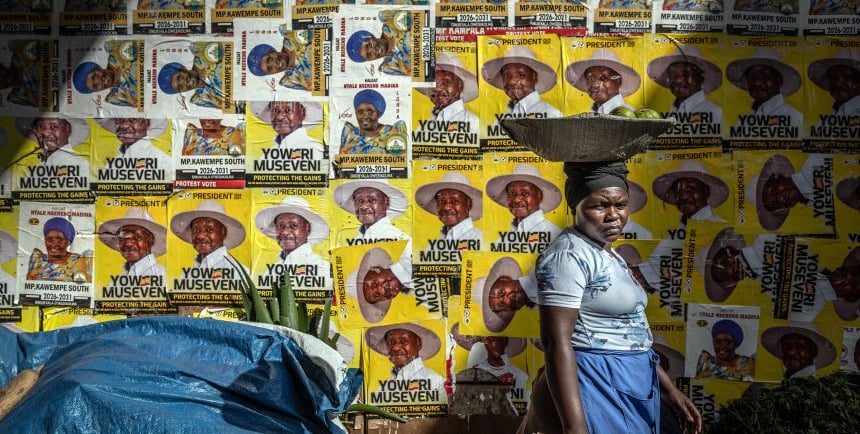
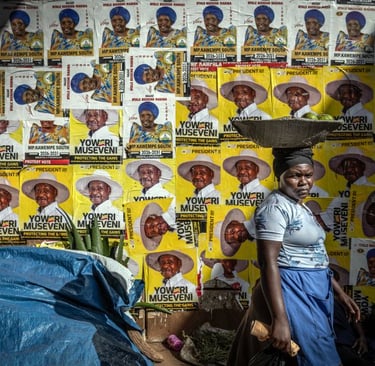
The 2026 Uganda's presidential elections represent a defining moment in the nation’s political trajectory. Far from being a mere periodic electoral exercise, this event serves as a critical test of the Ugandan political system’s capacity to facilitate a peaceful transfer of power after nearly four decades of President Yoweri Museveni’s leadership. While elections are theoretically designed as democratic instruments to express the popular will and renew political legitimacy, persistent concerns regarding the integrity of the process and the viability of genuine competition suggest a more complex reality. This situation raises a fundamental question: will the upcoming polls serve as a mechanism for democratic transition, or will they simply function as a tool to consolidate the governance style that has dominated Uganda for decades?
In light of these dynamics, this research paper provides a comprehensive analytical reading of the Ugandan political landscape ahead of the 2026 elections. The study evaluates the primary candidates and the map of party competition, analyzes the systemic challenges facing the electoral process, and monitors the key determinants of voter behavior. Finally, it outlines potential scenarios for the election results and their broader implications for the future of governance and political stability in Uganda.
Executive Summary
This paper examines the Ugandan presidential elections scheduled for January 2026, framing them as a pivotal juncture in the four-decade rule of President Yoweri Museveni. The analysis explores the shifting political dynamics preceding the vote, identifies the most prominent candidates, and scrutinizes the challenges threatening the electoral process. Furthermore, the paper investigates the socioeconomic factors influencing voting behavior among the Ugandan electorate and anticipates potential outcomes and their impact on the country's political future.
I. Analysis of the Ugandan Political Landscape Prior to the Elections
The upcoming presidential elections place Uganda at a historical crossroads. The outcome will determine whether the country moves toward a peaceful transfer of power that supports democratic life and popular aspirations, or whether it remains under the continued dominance of the existing regime.
The Ugandan political arena currently features a diverse field of candidates ahead of the elections, which are set to begin in mid-January 2026. The most prominent figure remains the incumbent, Yoweri Museveni, representing the National Resistance Movement (NRM). At 81 years old, Museveni has held power since 1986, marking one of the longest tenures in Africa. His candidacy for a seventh term was made possible by the 2017 constitutional amendment that removed presidential age limits. Notably, his campaign has highlighted his son, Muhoozi Kainerugaba, as a potential successor. This dynamic suggests a move toward a hereditary transition, which critics argue threatens the democratic process and transforms the election from a tool of change into a means of regime consolidation.
The most significant challenge from the opposition comes from Robert Kyagulanyi Ssentamu, better known as Bobi Wine, representing the National Unity Platform (NUP). Having secured 38.4% of the vote in 2021, Wine maintains a robust base among the youth and urban poor. His platform emphasizes democratic reform, anti-corruption measures, and economic revitalization to combat unemployment. However, his campaign continues to face significant hurdles, including the harassment and arrest of his supporters.
Other notable contenders include Mugisha Gregory Muntu of the Alliance for National Transformation (ANT), a former military commander making his second presidential bid. Representing the Forum for Democratic Change (FDC) is Nathan Nandala Mafabi, an economist and Member of Parliament focusing on income growth and economic reform. Additionally, the Common Man's Party (CMP) is represented by Munyagwa Mubarak Sserunga, who utilizes social media to target the youth demographic.
Further diversifying the field are Elton Joseph Mabirizi of the Conservative Party (CP), who advocates for direct citizen engagement and economic reform, and Bulira Frank Kabinga of the Revolutionary People's Party (RPP), who has prioritized systemic government reform—including potential revisions to presidential age limits. Finally, Robert Kasibante of the National Peasants Party (NPP) represents a newer voice in the political scene, campaigning on a platform of comprehensive state development.
While this diversity of candidates offers a theoretical opportunity for the elections to reflect the true will of the Ugandan people, the outcome depends heavily on the opposition's ability to navigate systemic challenges. Without a significant shift, the process may simply reproduce the existing ruling pattern rather than ushering in a new presidency.
The Map of Party Competition and Candidates
The Ugandan political arena currently features a diverse field of contenders representing a wide spectrum of political interests. The most prominent figure remains the incumbent, Yoweri Kaguta Museveni, representing the National Resistance Movement (NRM). He is challenged by several key opposition figures, most notably Robert Kyagulanyi Ssentamu (Bobi Wine) of the National Unity Platform (NUP), who represents the primary threat to the status quo. Other established political forces are also active, including the Alliance for National Transformation (ANT) led by Mugisha Gregory Muntu, and the Forum for Democratic Change (FDC) represented by Nathan Nandala Mafabi.
The competition is further broadened by candidates from smaller or more focused parties, such as Munyagwa Mubarak Sserunga of the Common Man's Party (CMP), Elton Joseph Mabirizi of the Conservative Party (CP), and Bulira Frank Kabinga of the Revolutionary Peasants Party (RPP). Additionally, the National Peasants Party (NPP) is fielding Robert Kasibante, rounding out a field that, while diverse, must navigate a political landscape heavily weighted in favor of the incumbent.
II. Primary Challenges Facing the 2026 Ugandan Elections
Several critical challenges threaten to undermine the 2026 elections, potentially reducing them to a formal exercise that reinforces the four-decade status quo.
Erosion of Credibility and Integrity: Persistent doubts regarding the independence of the Electoral Commission and the transparency of vote-counting mechanisms have fostered public skepticism. This lack of trust may lead to significant voter apathy, as citizens may view the process as a predetermined outcome.
Weakened International Oversight: Election monitoring has been hampered by a decline in international support. The termination of funding from the United States Agency for International Development (USAID) for voter education and the European Union’s previous reluctance to send monitoring missions—following the dismissal of their prior recommendations—have deepened concerns over the lack of rigorous oversight.
Opposition Suppression and Restrictions: The political climate is marked by intimidation, violence, and the arrest of opposition figures. The arrest of Kizza Besigye in November 2024 and the forceful dispersal of opposition gatherings illustrate a restrictive environment that stifles genuine competition.
Inequality of Opportunity: Disparities in campaign financing, alongside allegations of vote-buying, create an uneven playing field. This financial imbalance favors the incumbent regime, directly impacting voter choice and compromising the transparency of the electoral contest.
III. Determinants of Ugandan Voter Behavior
The behavior of the Ugandan electorate in 2026 will be largely shaped by deep-seated socioeconomic grievances. The extent to which candidates address these issues will determine their ability to mobilize the public.
Youth Unemployment: With youth unemployment reaching 43%, and only a fraction of graduates finding formal employment annually, the economic despair of the younger generation is a primary driver of political sentiment. Candidates who offer credible plans for job creation are likely to gain significant traction.
Systemic Corruption: Uganda’s low ranking on Transparency International’s Corruption Perceptions Index (140th out of 180) reflects a pervasive issue that affects the daily lives of citizens by inflating costs and limiting opportunities. Anti-corruption platforms remain a central interest for the electorate.
Poverty and Living Standards: Despite some statistical improvements, approximately 7 million Ugandans live below the extreme poverty line. Improving basic living conditions and addressing the 16.1% poverty rate are critical factors that will dictate the choices of a large segment of the population.
IV. Scenarios for the 2026 Ugandan Elections
Analysis of recent electoral trends in Africa (such as in Tanzania, Côte d'Ivoire, and Cameroon) suggests that incumbents often successfully manage the electoral process to maintain power. Based on this context, two primary scenarios emerge for Uganda:
Scenario 1: Continuation of the Existing Governance Pattern
In this most likely scenario, President Museveni secures a seventh term. This path is supported by the regime's effective neutralization of the opposition, the weakness of international monitoring, and the institutional advantages provided by previous constitutional amendments. The machinery of the NRM remains positioned to ensure the continuation of the current style of governance.
Scenario 2: An Opposition Breakthrough
While less probable, this scenario involves an opposition candidate—most likely Bobi Wine—breaking the current hegemony. This path relies on the opposition’s ability to capitalize on its popularity among the youth and urban poor to overcome systemic barriers. Such an outcome would signify a radical shift in Uganda's political structure.
Conclusion
The 2026 Ugandan presidential elections are unfolding within a complex political environment where the desire for stability is frequently at odds with the demand for reform. Despite a diverse field of candidates and palpable public support for change, systemic challenges—ranging from compromised electoral integrity to unequal resources—heavily favor the status quo.
While socioeconomic issues like unemployment and corruption are the primary drivers of voter behavior, the opposition’s current inability to translate popular discontent into decisive electoral gains makes a seventh term for President Museveni the most probable outcome. However, the potential for a new political equation remains. Should the opposition forces unite and effectively leverage growing public frustration, they could restore the role of the election as a genuine mechanism for peaceful change. Ultimately, the 2026 vote will be a decisive factor in determining the future of democracy and long-term stability in Uganda.
Follow African Narratives
Amplifying African voices for sustainable progress together.
Contact US
Connect
Street No. 3281, N'Djamena, Republic of Chad.
© 2026. All rights reserved.