Two Elections, Two Africas: What Ethiopia and Cabo Verde Reveal About the Limits of the Ballot
In 2026, two African nations held national votes within weeks of each other. One entrenched a crisis; the other defused one. The gap between them is a lesson in what elections can — and can't — do.
Kawthar Ahmed, Political Science Researcher
6/27/20265 min read
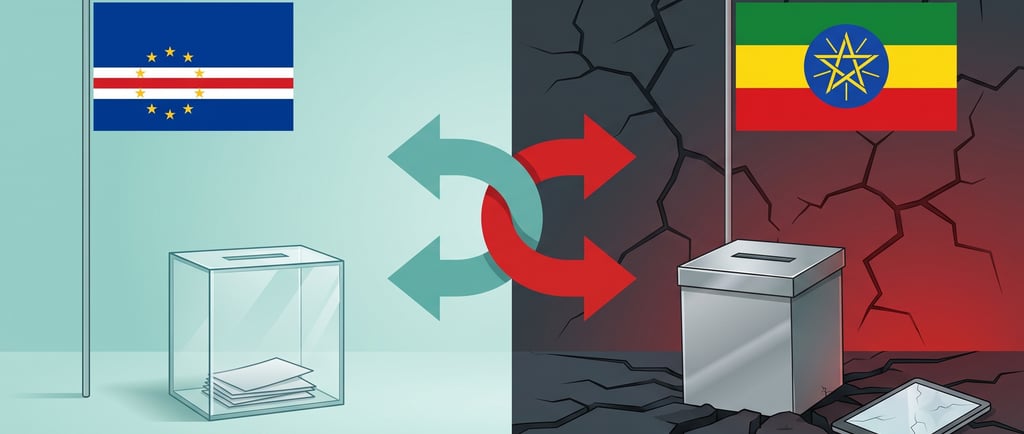
On May 17, 2026, the island republic of Cabo Verde handed power to its opposition in an orderly afternoon of voting. Two weeks later, on June 1, Ethiopia held a general election in which the ruling party won dozens of seats without facing a single opponent, while millions of citizens in conflict zones never got the chance to cast a ballot at all. Both events were, on paper, democratic elections. Yet they produced almost opposite outcomes — one reinforcing a fragile peace, the other hardening a national fracture.
That contrast is the heart of a recent comparative study by political scientist Kawthar Ahmed, which treats the two votes as a natural experiment. The countries differ on nearly everything — size, history, ethnic makeup, security — so what they share, and where they diverge, says something larger about democracy across the continent. The central finding is uncomfortable for technocrats: better voting technology does not produce better democracy. Stable institutions do.
Ethiopia: Modern Machinery, Broken Ground
Ethiopia's 2026 vote was its most technologically ambitious ever. The national election board let citizens register from their phones, piloted the country's new digital ID system to weed out duplicate voters, and signed up roughly 54 millionpeople across as many as 52,000 polling stations. Parliament put about 10.5 billion birr behind the effort, with another $7 million in technical support channeled through the UN Development Programme.
None of it could compensate for the fact that parts of the country were at war.
The election unfolded against a deeper argument about what Ethiopia should even be. Prime Minister Abiy Ahmed and his Prosperity Party have pushed a unifying national vision — branded Medemer, or "synergy" — that favors a stronger central state. Arrayed against it is a coalition of regional and ethnic movements who see the federal, autonomy-protecting system enshrined in the 1995 constitution as the only thing holding a multi-ethnic country together. That disagreement is not abstract. It runs straight through the regions where the fighting is worst.
In Tigray, the 2022 Pretoria peace deal had quieted the war but not settled the politics, and preparations for voting never got off the ground. In Amhara, intermittent clashes between federal forces and local armed groups made it impossible to campaign or deliver ballots across wide rural areas. In Oromia, an active insurgency left officials unable to guarantee the safety of polling stations. Facing these conditions, the board postponed or suspended voting in 46 constituencies, shrinking the contested parliament from its full 547 seats to 501 — and disenfranchising the entire Tigray region in the process.
The competition that remained was lopsided. Between 42 and 48 parties registered, but the Prosperity Party towered over a fragmented opposition split between a trans-ethnic, citizenship-based alternative (EZEMA, led by Berhanu Nega) and regional parties defending local autonomy. Ethiopia's winner-take-all electoral system — where the top vote-getter in each district takes the seat — already punishes small parties. Then key players removed themselves or were removed: the Oromo Liberation Front boycotted, and the Tigray People's Liberation Front was barred for failing to meet registration rules. The result was that the ruling party won roughly 75 seats completely uncontested, with no opponent on the ballot.
International observation reflected the unease. Western monitors largely stayed away; the African Union and the regional IGAD bloc led oversight instead. Their preliminary assessments praised the board's technical improvements but flagged the obvious problem — that excluding whole regions meant there was no level playing field. One online essay in the Journal of Democracy went further, branding the vote a "sham" before it was even held. That is a sharp characterization from one outlet, not a settled verdict, but it captures the core tension: a procedurally modern election held on politically broken ground.
The deeper consequence is what the result does next. With a commanding majority in both legislative chambers, the Prosperity Party now has the votes to rewrite the ethnic-federal bargain of 1995 and steer Ethiopia toward a more centralized state — the very outcome its opponents fear most. Because the citizens most opposed to that shift were also the ones least able to vote, the election settled the arithmetic without settling the argument.
Cabo Verde: Boring, and That's the Point
Cabo Verde offers the mirror image. On May 17, the archipelago filled all 72 seats of its National Assembly, and the results overturned the government: the center-left PAICV won an absolute majority, ousting the center-right Movement for Democracy (MpD), which had governed the previous term. The smaller UCID held its place as a third bloc. Power changed hands, and nothing broke.
What makes that unremarkable is exactly what makes it instructive. Since adopting multiparty rule in 1991, Cabo Verde has run on a stable two-party system under a 1992 constitution that splits authority between a directly elected president and a prime minister drawn from the parliamentary majority. The arrangement routinely produces "cohabitation," where the two top offices belong to rival parties — President José Maria Neves is rooted in PAICV, while outgoing Prime Minister Ulisses Correia e Silva led the MpD — and the country's political class has learned to manage that split without deadlock.
The plumbing is solid, too. The state's technology agency runs a biometric voter registry that blocks duplicate registration, syncs precinct data to headquarters in real time, and pushes encrypted preliminary counts to the public within hours of polls closing. Campaign spending is capped, foreign and anonymous donations are banned, and the Constitutional Court audits party finances. A gender-quota law requires women to make up at least 40% of candidate lists, with financial bonuses for parties that exceed it. As an island nation shaped by emigration, Cabo Verde even reserves three of its seats for the diaspora — one each for Africa, the Americas, and Europe-and-beyond — so citizens abroad help decide the balance of power at home.
The vote wasn't flawless: abstention topped 50%, a real weakness the study doesn't paper over. But the process was clean, the count was accepted by all sides, and the AU's observers reported no irregularities serious enough to question the result. Power transferred, investors stayed calm, and post-election risk assessments concluded the change of government wouldn't disrupt the country's economic course — because both major parties broadly agree on it.
The Comparison That Matters
Lined up side by side, the two votes isolate a single variable. Both countries embraced the same modern tools — biometric verification, digital registration, fast electronic tabulation. The difference wasn't technology. It was the institutional and security environment the technology was dropped into.
Where Cabo Verde had independent courts, enforced rules, and a baseline of political trust, those tools strengthened a system that already worked. Where Ethiopia had active conflict, contested legitimacy, and a board whose independence the opposition openly doubted, the same tools couldn't compensate for the absence of the things that make an election meaningful: genuine competition and the ability of citizens to actually vote.
The study draws three lessons from the pair. First, in conflict zones, procedural polish is not enough — a secure, inclusive baseline has to exist before voting can produce legitimacy rather than just a result. Second, durable party systems and independent courts are what let competition end in acceptance rather than violence; Cabo Verde's quiet handover is the proof. Third, electoral frameworks succeed when they balance international standards against local realities instead of importing one without the other.
The throughline is a caution against mistaking the act of voting for the substance of democracy. Elections are a mechanism for managing competition, but they cannot, on their own, knit together a divided nation or substitute for the slower work of building trusted institutions. In 2026, two African countries held elections by the same modern playbook and ended up in different places — not because one counted votes better, but because only one had built the constitutional ground those votes could stand on.
Download the full study here.
Follow African Narratives
Amplifying African voices for sustainable progress together.
Contact US
Connect
Street No. 3281, N'Djamena, Republic of Chad.
© 2026. All rights reserved.