Military Coups and Development in Guinea-Bissau: A Structural Analysis
By Kawthar Mubarak, Researcher in African Affairs
11/29/202515 min read
Abstract
This research paper examines the phenomenon of military coups in Guinea-Bissau since independence, viewing it as a structural feature linked to the formation of the modern state, the configuration of the political system, the nature of civil–military relations, and the profound impact of these dynamics on economic and social development, Through an analysis of historical, political, and economic dimensions, the study arrives at four central findings:
Military coups in Guinea-Bissau are not episodic events, but structural outcomes of an authoritarian colonial legacy and a post-independence state built on revolutionary–military foundations, where party and military have been intertwined from the outset, making the armed forces a persistent political actor.
Power struggles within the political–military elite, a weak constitutional framework, and repeated institutional breakdowns have turned coups into an instrument for resolving political conflicts, particularly during transitional moments, as observed in the coups of 1980, 1998–1999, 2003, 2012, and most recently 2025.
Coups have weakened state institutions and disrupted public policy, leading to diminished bureaucratic capacity, declining investment, increased poverty, reduced social spending, and the expansion of the informal economy—particularly drug trafficking networks—which has deepened state fragility and undermined sovereignty.
Sustainable development in Guinea-Bissau depends on breaking the cycle between political instability and poor economic performance through reforming civil–military relations, strengthening constitutional institutions, limiting the influence of illicit economies, and reinforcing governance and domestic legitimacy.
Military Coups and Development in Guinea-Bissau
Military coups in Guinea-Bissau—spanning from the country’s independence from Portugal to the most recent overthrow of President Umaro Sissoco Embaló—constitute a deeply rooted structural phenomenon that extends far beyond isolated or exceptional political events, The political system emerged within a domestic environment marked by profound social and ethnic complexity, weak formal institutions, and a burdensome colonial legacy that produced long-standing structural distortions, Regional and international dynamics have further reinforced instability, either by exacerbating domestic political tensions or by attempting to mitigate their consequences, As a result the military establishment has gradually transformed from an institution expected to perform defensive and security functions into a central political actor capable of reconfiguring power relations whenever the country faces acute political crises or significant disruptions in its electoral processes.
The recurrence of coups in Guinea-Bissau cannot be understood apart from the country’s broader economic and social development trajectory, Despite possessing important economic resources—particularly in the agricultural sector, cashew production, and fisheries—the country remains classified among the poorest in the world, characterized by severely underdeveloped infrastructure, high unemployment rates, and low levels of education and social services, Historical experience shows that successive coups and coup attempts have hindered the consolidation of stable governance institutions and obstructed the formulation and implementation of long-term development strategies, They have also facilitated the expansion of informal and transnational economic activities—most notably drug-trafficking networks—which contributed to the erosion of state legitimacy and further weakened the state’s capacity to enforce the rule of law.
Recent developments, particularly the coup against President Embaló and the establishment of a new transitional leadership, underscore the persistence of a structural cycle in which political crises intensify and trigger military intervention, This raises fundamental questions about the future of the state and its ability to break free from recurrent constitutional ruptures: Does the current transitional phase create an opportunity to articulate a new social and institutional contract capable of grounding the state on more stable foundations? Or does it represent a continuation of coercive political shifts that deepen state fragility and diminish prospects for sustainable development?
Based on this central problematic, the present report seeks to analyze the phenomenon of military coups in Guinea-Bissau and assess their cumulative impact on the country’s development trajectory, It adopts a multidimensional analytical approach that links the historical evolution of the political system, the institutional behavior of the armed forces, and key indicators of economic, social, and institutional development.
The Historical and Structural Framework of Military Coups in Guinea-Bissau
Military coups in Guinea-Bissau represent one of the most defining features shaping the trajectory of state formation since independence, The Bissau-Guinean state, which emerged following a prolonged armed liberation struggle against Portuguese colonialism, inherited a complex political and security legacy in which the revolutionary project became intertwined with the very structure of the military institution, This fusion positioned the armed forces as a central political actor, From the first decade after independence, the state was unable to build strong civilian institutions capable of regulating the relationship between the executive authority and the military, resulting in recurrent waves of coups, factional divisions, and constitutional ruptures.
Formation of the Modern State and the Trajectory of Coups from Independence to 2025
The postcolonial state in Guinea-Bissau was forged out of an armed liberation movement led by the PAIGC under Amílcar Cabral, who sought to construct a new national consciousness based on self-liberation and a decisive rupture with the colonial order, After the unilateral declaration of independence in 1973 and its official recognition in 1974, the party leadership—simultaneously the leadership of the armed forces—assumed direct control of the state. This established a model of governance grounded in revolutionary-military legitimacy rather than in strong constitutional foundations.
The country adopted the 1973 constitution, followed by the 1984 constitution, both of which entrenched a single-party system dominated by the PAIGC and concentrated power in the presidency and the Council of State, This configuration resulted in an almost complete fusion between state institutions, the ruling party, and the military establishment, effectively eliminating boundaries between the civilian and military spheres.
• The 1980 Coup and the Emergence of the Military as a Direct Political Actor:
The coup of 14 November 1980 marked the first forcible transfer of power in the post-independence era, as João Bernardo Vieira overthrew President Luís Cabral with the support of military factions, This coup unfolded amid significant political and economic tensions and intense competition within the military-party elite for influence, From that point onward, military intervention became a quasi-routine mechanism for restructuring power relations.
• The Major Military-Political Crisis of 1998–1999:
General Ansumane Mané led a coup attempt that escalated into a civil war lasting nearly a year and resulting in the fall of Vieira’s regime, This crisis exposed severe fragmentation within the armed forces, driven by politicized promotions, internal divisions among officers, and the military’s involvement in regional conflicts, most notably its support for the Casamance separatists in Senegal.
• The 2003 and 2012 Coups and the Internationalization of the Crisis:
The 2003 coup ousted President Kumba Ialá amid claims of poor governance and institutional paralysis, Less than a decade later, the 2012 coup occurred during a critical electoral transition, prompting direct intervention by ECOWAS, the suspension of Guinea-Bissau from the African Union, and the imposition of international sanctions aimed at pressuring the military to restore constitutional order.
• The Post-2012 Period Leading Up to the 2025 Coup:
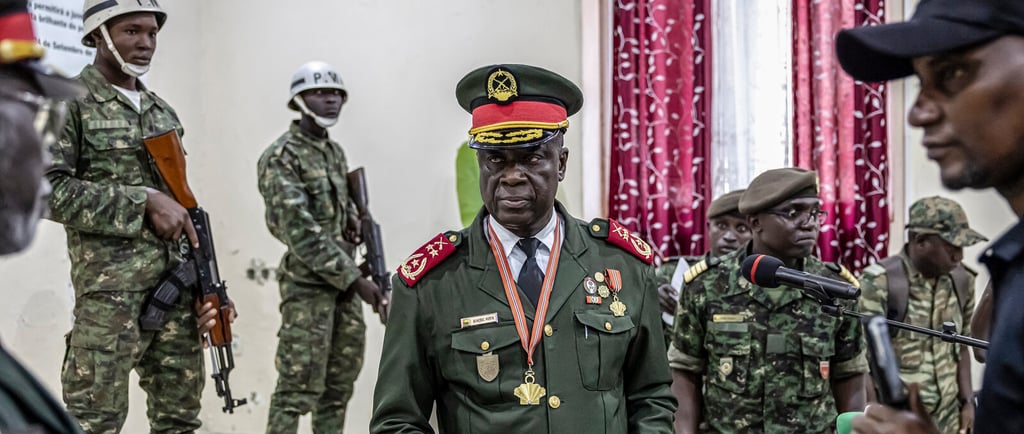
Despite the restoration of civilian rule after 2014, the country continued to experience repeated coup attempts, the most notable being the February 2022 attempt linked to the expansion of drug-trafficking networks along the West African coast. In November 2025, the military council overthrew President Umaro Sissoco Embaló, declared full control over state institutions, and established a transitional military leadership—thus perpetuating the structural pattern of constitutional disruption.
The Deep Structural Foundations Driving Military Coups
A review of Guinea-Bissau’s political history reveals a set of structural factors that render coups an expected outcome of long-standing institutional fragility, These can be summarized in four principal pillars:
• The Colonial Legacy and the Reproduction of an Authoritarian State Model:
Portuguese colonialism relied on a highly centralized administrative system governed directly from Lisbon, with no local representative structures or substantive civilian institutions, This left the post-independence state without institutional experience in managing political pluralism or regulating power, The one-party state reproduced this model by consolidating central authority and relying on coercive rather than constitutional mechanisms.
• The Organic Relationship Between the Party and the Military and the Weakness of Institutional Separation:
Since independence, the military has been integral to the political architecture of the ruling party, Political leaders used the armed forces to consolidate control, while military officers used force to influence political decisions, The absence of functional separation between the two institutions led to a circular pattern of mutual intervention and politicization of the armed forces, transforming the military into a parallel political actor.
• Ethnic Diversity and the Distribution of Power within the Military:
Guinea-Bissau’s society is characterized by significant ethnic diversity, with a strong presence of the Balanta group within the armed forces, This concentration created networks of military loyalty linked to ethnic affiliation, making the institution vulnerable to fragmentation during political crises, Political conflicts frequently manifested as internal divisions within the military, beyond the capacity of conventional institutional mechanisms to resolve.
• A Fragile Economy and the Expansion of Illicit Activities:
As one of the world’s poorest countries, Guinea-Bissau depends on a narrow agricultural base, Weak state institutions facilitated the expansion of the informal economy—particularly drug-trafficking—which became deeply embedded in the economic and political landscape from the early 2000s onward, This environment provided incentives for some military actors to control the state not only for political purposes but also to secure economic influence.
• Fragility of the Constitutional Framework and Governance Institutions:
Successive constitutions were repeatedly suspended, amended, or overridden, The state failed to build an independent judiciary and neutral electoral bodies, rendering coups a preferred mechanism for resolving political disputes, This contributed to the erosion of a culture of peaceful power transfer and entrenched the perception that military force constituted the fastest route to political authority.
The coups in Guinea-Bissau are thus not abrupt or unexpected events, but the cumulative product of long-standing structural crises rooted in the very formation of the state, The persistent lack of separation between the military and political spheres, institutional weakness, ethnic fragmentation, and economic vulnerability have interacted over decades to make coups a routine means of reorganizing power, This structural framework is essential for understanding the profound effects of repeated coups on Guinea-Bissau’s economic, social, and institutional development.
Military Coups and the Trajectory of Political Transformation in Guinea-Bissau
The relationship between the military institution and the trajectory of political transformation in Guinea-Bissau is central to understanding the challenges that accompanied state-building in the post-independence era, Since the first coup in 1980, the armed forces have become the most influential actor in shaping the political landscape, functioning as the “center of gravity” in moments of crisis and political transition, The importance of this section lies in analyzing how the military interacted with civilian governing institutions, and how successive coups and coup attempts affected state stability and the prospects for consolidating a democratic system based on pluralism and peaceful transfer of power.
The Coup as a Tool for Reconfiguring Power in Times of Crisis
The 1980 coup demonstrated that the armed forces had begun to view themselves as the “guardians of the political order,” and that direct intervention in governance constituted— from their perspective— a legitimate response to political deadlock or perceived weaknesses in civilian leadership, This event established a pattern that would be replicated in subsequent crises, in which coups became instruments for redistributing power or resolving internal struggles within the ruling elite.
• The Coup as a Mechanism for Managing Elite Competition
The 1998–1999 coup attempt revealed that competition for influence within the ruling party and state institutions could quickly escalate into armed confrontation in the absence of institutional mechanisms for conflict resolution, Studies indicate that the conflict between Vieira and his Chief of Staff, Ansumane Mané, was not a confrontation between a civilian authority and a military one, but rather a struggle within a single, intertwined structure of power, This underscores that the military was never a separate institution standing apart from the political system, but a structural component of the struggle for political control.
• The Coup During Democratic Transitions
The 2012 coup exemplified the fragility of the relationship between the military and the electoral process, Following the first round of the presidential elections, the military intervened to prevent the second round, citing alleged security threats to the country—an argument frequently invoked in many West African coups, This intervention suspended the electoral process and returned the country to temporary military rule, undermining confidence in the possibility of building a sustainable democratic system.
• Using the Coup to Control Networks of Economic Power
As Guinea-Bissau became a key transit point for cocaine trafficking to Europe, the struggle over state institutions—especially the military and security apparatus—became closely tied to managing networks of illicit economic gains, Evidence suggests that certain coup attempts, such as the 2022 incident, were linked to competition within the military over control of trafficking routes, thereby adding a significant economic dimension to political conflict.
The Impact of Coups on Civil Governance and Civil–Military Relations
• Weakening State Institutions and Entrenching a “Fragile State”
Repeated coups severely complicated the development of state institutions—particularly the parliament, judiciary, and electoral administration, Reports indicate that coups resulted in:
the dissolution or paralysis of parliaments, as occurred in 2003 and again in 2012;
the dismissal of elected governments and their replacement with military councils or transitional administrations;
the erosion of judicial independence through interference in appointments and the disruption of oversight mechanisms, According to the International Crisis Group, these recurring interventions contributed to the rise of a “fragile state” that functions intermittently and lacks the institutional capacity to manage public affairs effectively.
• Recycling Elites and Hindering Political Renewal
Coups typically lead to the reproduction of the same political elites rather than genuine political renewal, Many military leaders who rose to power through coups later reappeared in the political sphere, either through direct governance or by forming political parties, This pattern—common in West African states—illustrates how the military is often used as a vehicle to attain power before transitioning into civilian political roles.
• Undermining Public Confidence in the Democratic Process
The experiences of 1999, 2012, and 2025 demonstrate a gradual erosion of public trust in elections as a means of achieving peaceful power transfer, Even when relatively free elections were held, such as in 2014 and 2019, the persistent threat of military intervention rendered democratic processes incomplete and heavily dependent on external support.
• Excessive Reliance on Regional and International Intervention
Institutional fragility has forced Guinea-Bissau to rely almost entirely on the intervention of ECOWAS, the African Union, and the United Nations to manage political crises, ECOWAS has mediated negotiations, imposed sanctions, and deployed peacekeeping forces following the 2012 coup, while neighboring states—such as Senegal—played critical roles during sensitive stages of crises, This sustained dependence on external mediation highlights the state’s limited capacity to settle its internal disputes and obstructs the development of resilient, self-sustaining institutions.
An analysis of Guinea-Bissau’s political transformation reveals that military coups have not been mere reactions to political disorder but have evolved into structured mechanisms for reconfiguring power within the state, The interwoven nature of the military, the ruling party, and state institutions has enabled the armed forces to obstruct democratic transitions whenever these threatened their interests, Recurrent coups have weakened state institutions, reproduced entrenched elites, undermined public trust in electoral politics, and compelled the country to rely heavily on regional and international mediation.
The Impact of Military Coups on the Development Trajectory in Guinea-Bissau
The impact of military coups on development in Guinea-Bissau is one of the key lenses through which the country’s persistent failure to establish a sustainable development model can be understood, Despite possessing notable agricultural resources and a coastal position that could support multiple economic sectors, Guinea-Bissau continues to be ranked among the poorest and most fragile states in the world, This condition is not attributable merely to resource scarcity, but to state weakness generated by repeated coups, constitutional breakdowns, the disruption of governing institutions, instability in public policy, and the erosion of the state’s capacity for planning and implementation.
State Paralysis and the Erosion of Developmental Governance
• Policy Instability and the Impossibility of Long-Term Planning
Repeated coups have led to sudden changes in government, the suspension of constitutions, and continuous restructuring of state institutions, Consequently, economic policies have been short-term, inconsistent, and unsuitable for building strategic development plans, The International Crisis Group shows that post-coup governments lacked the capacity to implement five-year plans or long-term strategies requiring political and institutional stability Frequent changes in bureaucratic leadership and the politicization of administrative structures after each coup brought decision-making to a standstill, disrupting rural and agricultural development programs—the backbone of the national economy.
• Weak Capacity to Manage Public Resources
Academic analyses indicate that coups have weakened financial oversight and contributed to the fragmentation of state institutions responsible for resource management, such as the ministries of finance, agriculture, and fisheries, The absence of accountability often resulted in mismanagement of public funds, the suspension of development projects, and a decline in donor confidence in the state’s ability to utilize aid effectively.
• Bureaucratic Paralysis
Coups have led to continuous turnover in high-level state positions, producing an unstable administrative environment characterized by personal loyalties rather than professional competence, Carlos Cardoso notes that this structure created a “fragile bureaucracy” unable to implement or monitor public policy, contributing to delays in improving critical infrastructure such as roads, ports, and public services.
Direct Economic and Social Consequences of Coups
• Decline in Economic Growth and Contraction of Investment
ECOWAS reports that coup periods are consistently associated with sharp declines in both domestic and foreign investment due to the absence of legal guarantees and uncertainty regarding policy continuity, Political instability has increased transaction costs, restricted capital movement, and slowed economic growth—particularly in sensitive sectors such as cashew production, the country’s primary export commodity.
• Rising Poverty and Increased Social Vulnerability
Coups weakened the state's ability to deliver essential public services such as education, health, and sanitation, United Nations data indicate that poverty rates rose after each major political crisis due to halted development projects, declining international aid, and economic disruption, Reduced social spending further damaged health and education outcomes, making it difficult to build human capital capable of supporting long-term development.
• Expansion of the Informal Economy and the Growth of Criminal Networks
Political fragility has accelerated the spread of the informal economy, especially smuggling along the coastline and in the archipelago, UNODC reports that Guinea-Bissau has been one of the primary transit points for cocaine from Latin America to Europe since the mid-2000s—a phenomenon increasingly linked to political conflicts and coup attempts, This shift produced several effects:
a decline in state tax revenues;
the rise of organized crime networks;
the undermining of the rule of law, obstructing formal economic development;
and direct harm to key sectors such as agriculture and fisheries.
Since agriculture contributes nearly 49 percent of GDP, any political disruption directly affects production, whether through reduced financing, transportation breakdowns, or unstable market prices, Weak maritime oversight—exacerbated by political instability—has also increased illegal fishing, reducing revenues from the fisheries sector.
Loss of International Trust and Decline in Development Assistance
• Erosion of the State’s External Legitimacy
Repeated coups led to the suspension of the country’s membership in international organizations—such as the African Union after the 2012 coup—and to the imposition of political sanctions, these measures reduced access to grants and concessional loans, Weak commitment to democratic processes also discouraged the European Union and the World Bank from maintaining strong development programs.
• Conditional and Limited Donor Engagement
Although some international assistance continued, it often came with conditions tied to political and security reforms that the state lacked the institutional capacity to implement, Studies on political transitions in West Africa show that political instability undermines the “developmental effectiveness” of aid and limits the likelihood of achieving tangible outcomes.
Thus, coups generated a self-reinforcing cycle: instability reduced aid effectiveness, and weakened aid further eroded state capacity.
Military coups in Guinea-Bissau have produced a highly unstable political and economic environment that has severely constrained the state’s ability to achieve development across economic, social, and institutional dimensions, Continuous changes in political leadership, institutional weakness, the expansion of illicit economies, and declining confidence among both donors and citizens have prevented the formulation of a viable developmental model.
Consequently, military coups are not merely political crises but structural forces that entrench fragility and impede the emergence of a state capable of long-term planning, effective governance, and sustainable development.
Conclusion
An analysis of the historical and structural trajectory of military coups in Guinea-Bissau reveals that, since independence in 1974, the state has remained captive to a complex interplay of a burdensome colonial legacy, a political–military structure shaped in the context of an armed liberation struggle, and chronic institutional fragility that has prevented the consolidation of civilian governance, The modern state emerged on the basis of revolutionary–military legitimacy, making the armed forces an integral component of the power structure rather than a merely executive apparatus subject to civilian oversight, This entanglement between the party and the military created a political pathway marked by recurrent coups, through which military intervention became a mechanism for managing internal elite conflicts rather than relying on constitutional and institutional channels.
Tracing political developments from the 1980 coup through the 2025 coup demonstrates that coups have become a structural pattern of power transfer during periods of crisis, They have weakened the foundations of civilian rule, undermined citizens’ confidence in democratic institutions, and disrupted mechanisms of peaceful political settlement, Coups have also contributed to the reproduction of narrow elite circles, while the political system continued to depend on regional and international mediation to resolve crises instead of building self-sustaining national institutions.
On the developmental front, coups left deeply damaging effects on the state's capacity to construct a sustainable development model, repeated constitutional ruptures disrupted economic planning, destabilized public policy, paralyzed the bureaucracy, contracted investment, reduced social spending, and increased poverty and unemployment, Political and security fragility facilitated the expansion of the informal economy—especially transnational drug trafficking—which further eroded state sovereignty and weakened its ability to regulate the economic sphere and support rural and maritime development, the core of the national economy.
These findings lead to a central conclusion: Guinea-Bissau’s path toward sustainable development depends on its ability to break the vicious cycle linking political instability with weak development outcomes, Achieving this requires a fundamental restructuring of the civil–military relationship, strengthening of the constitutional framework, enhancing institutional independence, reforming the security sector, activating mechanisms of accountability and good governance, and limiting the penetration of illicit economies into state institutions, Although regional and international support remains important, it cannot substitute for the construction of domestic legitimacy grounded in national consensus and effective institutions.
Guinea-Bissau will not be able to achieve a stable democratic transition, nor build a competitive and growing economy, unless the structural roots of the political crisis— which have entrenched the dominance of coups and obstructed development for more than five decades—are addressed, This conclusion provides a foundation for shaping future political and economic reform strategies and designing more effective development interventions in the context of a state marked by chronic fragility, yet still possessing real potential for recovery if conditions of political stability and sound governance are secured.
References
Joshua B Forrest, Guinea-Bissau: Power, Conflict, and Renewal in a West African Nation, Boulder: Westview Press, 1992.
Carlos Cardoso, “The Post-Colonial State in Guinea-Bissau.” Review of African Political Economy 30, no. 97 (2003).
Galli, Rosemary, and Jocelyn Jones, Guinea-Bissau: Politics, Economics and Society, London: Frances Pinter, 1987.
Kawthar Mubarak, The Political System in Guinea-Bissau, Master's Thesis, College of African Studies, 2020..
ECOWAS Commission, Reports and Resolutions on Guinea-Bissau (2012–2023), Abuja: ECOWAS.
Guinea-Bissau, The World Factbook, Guinea-Bissau - The World Factbook
International Crisis Group, Guinea-Bissau: In Need of a New Elite, Africa Report 261, Brussels: ICG, 2018
Paula Cristina Roque,, “The Politics of Military Reform in Guinea-Bissau,” African Security Review 21, no. 4 (2012).
United Nations Office on Drugs and Crime (UNODC), Transnational Trafficking and the Rule of Law in West Africa: A Threat Assessment, Vienna: UNODC, 2009.
International Crisis Group, Guinea-Bissau: In Need of a New Elite, Africa Report 261, Brussels: ICG, 2018.
Henrik Vigh, Navigating Terrains of War: Youth and Soldiering in Guinea-Bissau, New York: Berghahn Books, 2006.
ECOWAS Commission, Reports and Resolutions on Guinea-Bissau (2012–2023), Abuja: ECOWAS.
International Crisis Group, Guinea-Bissau: In Need of a New Elite, Africa Report 261, Brussels: ICG, 2018.
ECOWAS Commission, Reports and Resolutions on Guinea-Bissau (2012–2023), Abuja: ECOWAS.
UNODC, Transnational Trafficking and the Rule of Law in West Africa: A Threat Assessment, Vienna: UNODC, 2009.
Follow African Narratives
Amplifying African voices for sustainable progress together.
Contact US
Connect
Street No. 3281, N'Djamena, Republic of Chad.
© 2026. All rights reserved.