Africa's Hydrogen Advantage: The Continent Positioning Itself to Power Europe's Energy Transition
From the Sahara's solar fields to Namibia's windswept coast, a new energy corridor is taking shape — if both continents can bridge the gap between promise and pipeline.
Nashwa Abdelnaby, Political Researcher
7/24/20264 min read
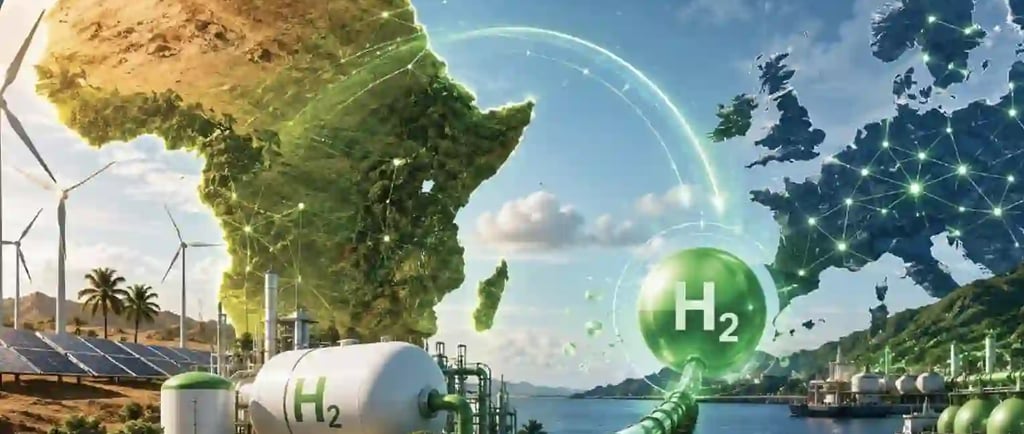
Europe needs clean molecules, and it cannot make enough of them at home. As the continent races toward carbon neutrality, green hydrogen — produced by splitting water with renewable electricity — has emerged as a leading candidate for decarbonizing industry, transport, and power generation. But Europe is not among the world's most favorable regions for producing it. Africa, by contrast, holds some of the planet's richest solar and wind resources, and a new study by researcher Nashwa Abdel Naby argues that this asymmetry could become the foundation of a strategic energy partnership between the two continents.
Why Africa holds the cards
The economics are straightforward: green hydrogen is only as cheap as the renewable electricity that feeds it, and Africa's electricity inputs are abundant and inexpensive. According to a 2024 study by the Hydrogen Council and McKinsey & Company cited in the paper, adopting green hydrogen could increase Africa's exports by approximately $15 billion while creating nearly 13 million new jobs by 2050. A separate study supported by the European Investment Bank estimates the continent could produce up to 50 million tonnes of green hydrogen annually by 2035 — though unlocking that potential would require investments of roughly €1 trillion.
The employment projections are equally striking. The German development agency GIZ estimates the green hydrogen economy could create around one million jobs by 2030 across countries including Morocco, Namibia, Tunisia, South Africa, Kenya, and Egypt, rising to between 3.5 and 4.5 million by 2050. Green hydrogen projects could also raise GDP by an estimated 6% to 12% in six key countries. Momentum is already institutional: the Africa Green Hydrogen Alliance, founded in 2022 by Egypt, Kenya, Mauritania, Morocco, Namibia, and South Africa, is working on financing mechanisms, capacity building, and regulatory development.
The North African front-runners
The study assesses nine countries, and North Africa dominates the near-term picture — largely because of proximity to European markets and existing energy infrastructure.
Morocco combines strong, stable coastal winds around Tarfaya and Dakhla with solar irradiation averaging around 5 kWh/m² per day, ideal conditions for hybrid solar-wind systems. Production costs at the priority sites of Dakhla and Laayoune are estimated at roughly $2.54–2.56 per kilogram of hydrogen. Its position near the Strait of Gibraltar offers direct access to Europe, and the planned Nigeria–Morocco Gas Pipeline — a 5,660 km route crossing thirteen West African countries — could further cement its role as a regional energy hub.
Egypt pairs enormous theoretical capacity — approximately 350 GW of wind and 650 GW of solar — with established renewable assets, including Africa's largest solar installation, the 1.8 GW Benban Solar Park near Aswan. Unlike Morocco and Algeria, Egypt currently lacks direct pipeline access to Europe, but a feasibility study has examined an 1,800 km link from Port Said to Calabria in Italy that could bring hydrogen costs down to €2.7/kg by 2030 and €2.3/kg over the long term. Freshwater scarcity, however, remains a significant constraint.
Algeria's vast, sparsely populated desert interior offers major renewable potential, with the Adrar region standing out for wind-based hydrogen production — though the study notes that wind energy remains underutilized and solar photovoltaics dominate the country's renewable mix. Tunisia, meanwhile, has faced delays from administrative, regulatory, and financing challenges, but is making partial progress through international partnerships, including support from Italy's Ministry for Environment and Energy Security. Its southern regions such as Kebili enjoy solar irradiation of up to 5.8 kWh/m² per day, and the proposed GALSI pipeline to Italy via Sardinia — still at the planning stage — has been discussed as a potential hydrogen route.
Southern Africa's export ambitions
At the other end of the continent, two countries anchor a second export zone. South Africa's hydrogen roadmap calls for 10 GW of electrolysis capacity in the Northern Cape and at least 500,000 tonnes of annual production by 2030, scaling to 15 GW by 2040. With roughly 2,500 sunshine hours per year and solar radiation between 4.5 and 6.6 kWh/m², the country ranks among the top three globally in solar potential.
Namibia may be the continent's most concentrated opportunity. Its solar irradiation of 2,200–2,400 kWh/m² annually is among the highest in the world, and coastal wind sites can reach capacity factors of 50%. The country targets 1–2 million tonnes of hydrogen production annually by 2030 and 5–7 million tonnes by 2040, with flagship ventures like the HYPHEN project signaling serious intent. Studies cited in the paper suggest that importing Namibian green hydrogen to Belgium could be economically viable, particularly as solar panel and electrolyzer costs continue to fall.
The remaining candidates — Nigeria, Ghana, and Kenya — are earlier-stage prospects. Nigeria's grid still runs about 78% on natural gas, though GIS-based analysis found 61 of 95 municipalities in the country's southeast suitable for hydrogen projects. Ghana has substantial technical potential but faces grid connectivity gaps between its sun-rich north and infrastructure-dense south. Kenya, targeting 100% renewable energy by 2030, sees its most cost-effective sites near Lake Turkana, home to one of Africa's largest wind farms at 310 MW.
Building the corridor
The connective tissue between production and demand is where the project gets hard. Energy already flows north: approximately 1,800 petajoules are exported annually from North Africa to Italy and Spain through pipelines and LNG infrastructure. The study argues that pipeline transmission is cost-competitive with high-voltage electricity transmission for moving large energy volumes over long distances, and research on converting existing gas networks in Germany and Europe suggests hydrogen can be distributed through repurposed pipelines at far lower cost than building new infrastructure. Maritime transport — the route South Africa is banking on — remains viable under strict technical conditions, typically requiring conversion to liquefied hydrogen, ammonia, or methanol.
The potential payoff is substantial: North African suppliers could generate export revenues of up to €50 billion annually by 2050, according to estimates cited in the study.
The equity question
The paper is careful not to present this as a frictionless win-win. Beyond financing gaps, geopolitical risk, and the need for regulatory harmonization, it flags genuine equity concerns: land displacement risks, competition over scarce water resources, and the danger of unequal benefit-sharing — particularly if exports to Europe are prioritized over domestic energy access in producing countries. European environmental assessments cited in the study make cooperation conditional on mutual benefit: clean energy for Europe, but real economic development and fair returns for African communities.
That framing is ultimately the study's central argument. An Africa–Europe hydrogen corridor could strengthen European energy security while channeling investment, infrastructure, and industrial growth into Africa — but only if it is built as a balanced partnership rather than an extractive one. Done right, the authors suggest, it could serve as a global model for a low-carbon economy founded on cooperation and integration rather than competition. Done carelessly, it risks reproducing old asymmetries under a green banner.
Download the full study here.
Follow African Narratives
Amplifying African voices for sustainable progress together.
Contact US
Connect
Street No. 3281, N'Djamena, Republic of Chad.
© 2026. All rights reserved.