A Fence, a Deadline, and a Diplomatic Rift: Inside South Africa's Migrant Crisis
Why South Africa, one of Africa's most stable economies keeps producing some of its most volatile anti-migrant violence — and why blaming migrants misses the real story.
Ahmed Gamal El-Sayyad, Political Science Researcher
7/7/20264 min read
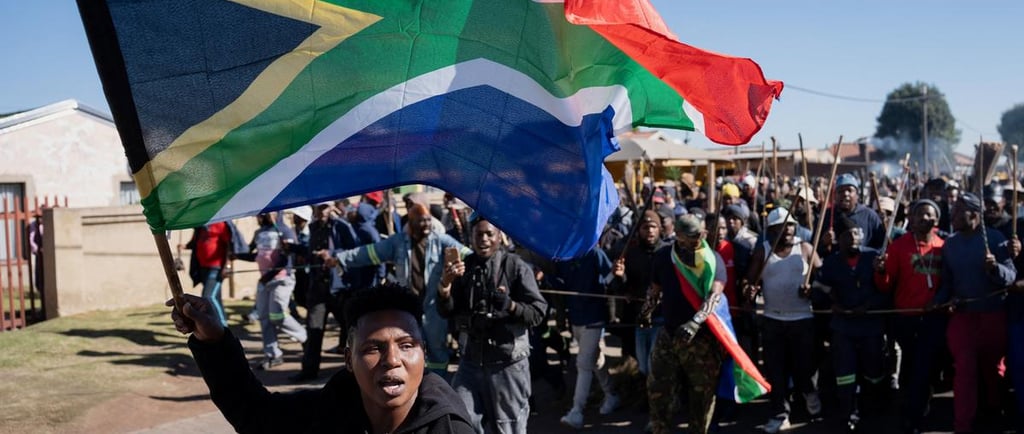
South Africa has spent decades as Africa's magnet economy — a place migrants from a dozen neighboring countries have gone to build better lives. It's also spent decades as the site of recurring waves of violence against those same migrants, waves that have grown sharper, more organized, and more diplomatically costly in recent months. Nigeria and Ghana have evacuated citizens. A movement called March & March has set a deadline for undocumented migrants to leave the country. And beneath the headlines sits a harder question: is this violence really about immigration, or is it a symptom of something else entirely — unemployment, inequality, and a political class that has found immigrants a convenient target?
South Africa: A Magnet Economy, Built on Migration
South Africa's pull on migrants isn't new — it's structural, and it goes back centuries. Dutch and British colonizers arriving from 1652 onward built the country's early economy on forced labor, bringing an estimated 65,000 enslaved people to South Africa, more than a quarter of them from elsewhere on the continent. The discovery of gold and diamonds in the late 19th century turned that pull into a flood: by the early 1900s, roughly 94,000 African migrant workers powered South Africa's mines, drawn from Malawi, Mozambique, Lesotho, Botswana, and Swaziland. The state's response was control, not welcome — the 1913 immigration law admitted only male workers, barred them from bringing families, and confined them to segregated housing.
Apartheid intensified that pattern: between 1947 and 1994, the regime forcibly resettled roughly 3.4 million people, 2.7 million of them Black South Africans, while tightening the border against refugees fleeing wars in neighboring states. After apartheid fell, migration surged again — the country absorbed roughly 916,300 immigrants between 2011 and 2016, and 853,000 more between 2016 and 2021. Today South Africa hosts an estimated 2.9 million migrants, a figure likely understated given the scale of undocumented arrivals, with the largest numbers coming from Zimbabwe, Mozambique, Lesotho, Malawi, and Ethiopia. It remains one of the continent's largest economies, with the African Development Bank projecting GDP growth from 1.1% in 2025 to 1.6% by 2027 — modest, but enough to keep the country a relative outlier of stability in the region.
When the State Itself Turns Hostile
The violence isn't confined to street-level mobs — it has run through government policy too. During the COVID-19 lockdowns, South Africa denied migrants access to state relief programs like food parcels, even as officials publicly implied that protecting South Africans from the virus mattered more than protecting migrants. The government built a 40-kilometer, 37-million-rand border fence with Zimbabwe under the banner of pandemic control — at a moment when South Africa had 1,845 confirmed COVID cases to Zimbabwe's 11, a mismatch that undercuts the public-health rationale and points instead to nationalist politics. A cabinet minister ordered the closure of foreign-owned spaza shops on quality grounds, casting migrant-run stores as sources of counterfeit and even poisoned goods.
At the grassroots level, anti-migrant sentiment has organized itself into movements with real reach. "Put South Africans First" emerged on X during the 2020 lockdown, generating 16,000 uses of its hashtag in a single day. Operation Dudula, based in Soweto, ran a "Clean Up Soweto" campaign that succeeded in expelling migrants from Zimbabwe and Mozambique — and, in the process, wrongly expelled South African citizens mistaken for foreigners. More recently, March & March, founded in 2025, has organized protests across Johannesburg, Pretoria, Durban, and beyond, and set June 30 as a deadline for undocumented migrants to leave — without saying what happens to those who don't. Given the climate, that silence reads less like an oversight and more like a threat.
The toll is measurable. Xenowatch, a project at the University of the Witwatersrand, has tracked 669 deaths, more than 127,000 people displaced, and over 5,300 looted foreign-owned businesses in xenophobic attacks between 1994 and 2024 — including a single month in 2008 when violence struck more than 135 locations. Mozambique's government recently reported five of its citizens killed and 300 repatriated after renewed attacks.
The Real Drivers: Economics, Politics, and Language
The paper's central argument is that this violence can't be explained by migration numbers alone. Unemployment in South Africa hit 31.4% in early 2026, and poverty — while down from 46.7% in 2015 to 37.9% in 2023 — remains stubbornly high. Those pressures have made migrants an easy political target: parties including ActionSA, the National Alliance Party, and uMkhonto weSizwe frame migrants as job competitors and a drain on public services, while the Inkatha Freedom Party and Freedom Front Plus have called for tighter border controls to protect, respectively, the labor market and "cultural identity." As one member of the Consortium for Refugees and Migrants in South Africa put it, much of this hostility grows out of "widespread frustration over unemployment, economic and social problems, and the lack of effort to reduce inequality" — frustration that gets redirected at migrants rather than at its actual causes. Nigeria's consul general has pushed back directly, noting that migrants make up less than 10% of South Africa's population and cannot reasonably be blamed for the country's poverty or unemployment rates.
Language does its own damage here. Campaign rhetoric built around words like "cleansing" and "criminals" isn't neutral — it primes citizens to see violence against migrants as a reasonable response to national problems, rather than as violence against scapegoats.
A Widening Diplomatic Fallout in South Africa
The consequences are no longer just domestic. The current violence has revived memories of South Africa's 2021 unrest, which killed more than 100 people and cost billions in economic damage. Nigeria has evacuated 268 citizens; Ghana has evacuated 300, with another 800 registering their wish to leave. Diplomatically, Nigeria's foreign minister has accused South Africa of failing to condemn the violence, while Ghana's foreign minister has pushed to put the attacks on the African Union's agenda and is weighing international legal action — a move South Africa's own foreign minister says the country will "vigorously defend" against. Tensions like these threaten more than bilateral relations; they strike at the foundation of African economic integration, which depends on stable relationships among the continent's states.
The paper's conclusion is blunt: migrants are not the cause of South Africa's unemployment, crime, or strained public services — they are a convenient explanation for problems that are structural. Addressing the violence, it argues, requires treating it as a security and political priority in its own right: a national strategy tackling unemployment and poverty, deeper migration cooperation with neighbors and the African Union, and firm, consistent enforcement against both violent acts and the officials or politicians who legitimize them through hate speech.
Download the full study here.
Follow African Narratives
Amplifying African voices for sustainable progress together.
Contact US
Connect
Street No. 3281, N'Djamena, Republic of Chad.
© 2026. All rights reserved.